𝕿𝖍𝖊 𝕭𝖞𝖙𝖊
Byte-sized thoughts, musings, art and Martyr the Bride updates from yours truly!
No, It’s not What it looks like…
My Thoughts on how visual metaphors are used in the arts, and the decline in media literacy.
One comment I occasionally get that never fails to make me laugh, is that my art looks evil or demonic. It’s a sentiment I rarely challenge directly in the moment, mainly because I don’t believe I need to explain or defend my work. But I would like to talk about it!
First let me just say— a depiction of darker themes or creatures is not an endorsement of those things.
We laugh at people who were clutching their pearls when movies like The Exorcist debuted, or at folks who thought nerdy kids playing Dungeons and Dragons were devil worshippers, because we understand what fiction is, and the majority of us know these things are harmless.
the purpose of darker themes in art and fiction
Eons ago, the first humans gathered around fires to tell stories to each other. The myths and folklore that people of the past created are a direct map of the values and beliefs that each culture held.
Stories of cryptids, demons, ghosts and mythical beasts serve as more than just entertainment. The characters and creatures are metaphors to depict specific concepts, often related to our deepest fears or subconscious mind.
Why does there need to be depiction a villain or a boogeyman or a demon possessing a little girl? If we write, draw, paint or otherwise dream up these things, are we not inviting evil into our hearts and minds?
No, of course not. There are passages about the devil in the Bible, and one purpose of this inclusion is to create contrast the good works of Jesus. If you remove the darker elements and themes, you miss half the story, and that half is arguably the most important.
Take for example, the Tale of Two Wolves— a native American folk tale in which an old Cherokee Indian tells his grandson that two wolves are fighting within him. The good wolf is the side of him that represents peace, love, humility and kindness, and the bad wold is evil, anger, sorrow, regret, greed, self-pity and false pride. The grandson asks which wolf will win, and the old man says “the one you feed.”
The wolves aren’t real in the story, but the message is: what you ‘feed’ or give power and thought towards is what you will become or be consumed by, with the story suggesting that the fate of the proverbial wolves are entirely the choice of the individual.
The term ‘media literacy’ refers to the ability to analyze, interpret, evaluate and connect with messages in all forms of media, including books, music, movies, video games and works of art.
Media literacy declines when reading literacy declines. If you do not immerse yourself in metaphor and elements of story telling, you will not understand their purpose beyond simple entertainment.
I don’t make art or write things that I think are ‘cool’, I do so, because there is something within me I am trying to explore and document… (and sometimes they just so happen to look cool, also).
The Creepy, evil, and weird visuals in my art
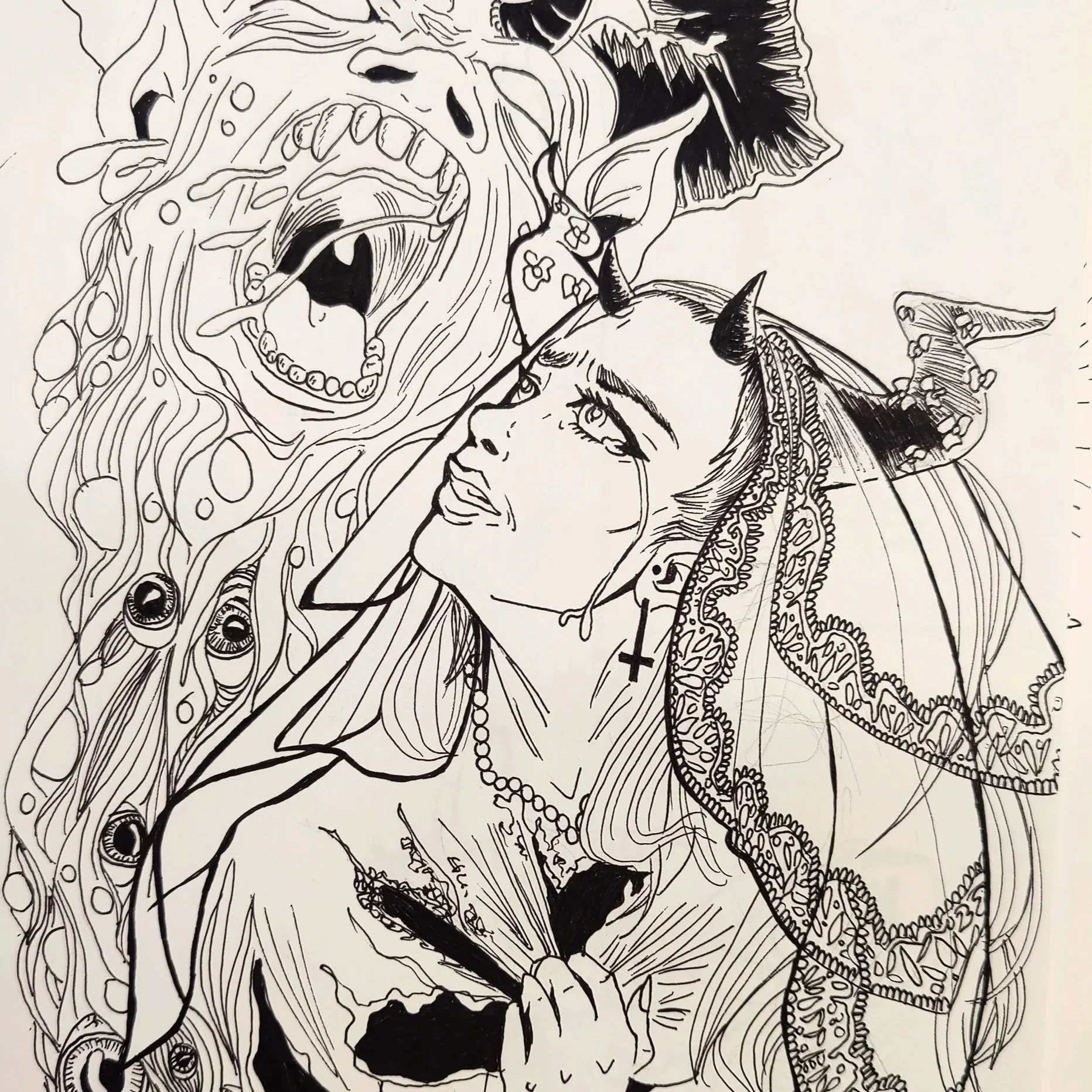
Within my illustrations you’ll see upside-down crosses, ram and devil horns, distorted faces, blood, floating eyeballs, etc.
I don’t depict this stuff for shock value or to piss off or concern family members. This is where media literacy is important. The visual metaphors are tools to convey things, or in my case explore them.
My art is not conclusive, there isn’t a singular correct way to interpret it, and my job as the creator is to create things, not explain what I’ve made.
While I won’t explain individual works, I’ll talk about common elements I use.
Upside-Down Crosses: Saint Peter’s Cross
According to the website Catholic Answers: In early Christian tradition, (found in the 2nd-century Acts of Peter and later writings by Origen, Tertullian, and Jerome—Peter) requested to be crucified upside down during Emperor Nero's persecution because he felt unworthy to die in the same manner as Jesus.
In my artwork for Martyr the Bride, Chase is seen wearing a large black upside-down cross as an earring. The Saint Peter’s cross symbolized his martyrdom, and Chase wearing it, represents hers.
The Romans nailed many people to crosses, not just Jesus, this was one way to torture and execute people. The cross itself is akin to a guillotine, when we contemplate the gruesome historical reality of their use.
Chase wearing an upside-down one, represents her defiance to authority, that being her spouse and the people in the eerie town of Ezra.
Devil Horns: Ram horns
Early Christian visual metaphor borrowed the symbol of horns and horned creatures from pagan folklore and mythos. Modern day Christian interpretation is that horns on a humanoid figure are an indicator that that character represents evil.
However, this is just popular opinion and cultural framing. For pagans, ram horns represent themes like: determination, protection, spiritual reflection and strength. Modern fantasy use horns to depict repressed desire, trauma or hidden truths.
You see many applications of horns as a metaphor in my work. Many of my self-portrait drawings show me with great, curling horns that spiral outward, giving the appearance of a crown.
I do this to signify the way I am viewed and treated as an autistic woman, and person with Complex Post Traumatic Stress Disorder, by people.
In this way, I am leaning into being different, being labeled difficult or treated like a scapegoat. I am holding up the mirror and reflecting what is cast upon me. I also use horns in my portraits to depict personal power and freedom.
Blood and body distortions: negative energy and Transformation
‘Bite back. Bleed black.’ is a phrase that Layne tells Chase in Martyr the Bride. Layne is Chase’s guardian angel, and in saying this, he is telling her to stand up for herself and take action (bite back), and to let go of or dismantle toxic beliefs and toxic relationships (bleed black).
A lot of my art depicts blood or ink spilling out over bodies or down from wings or plant leaves. The blood often represents pain, emotional intensity, and ego death. Blood is powerful both in real life and in fiction and visual metaphor.
It represents the innocent and the slain, sacrifice and rebirth, destruction and creation.
The bottom line: Don’t Fear ‘the Reaper’
In his poem ‘To Comfort The Disturbed, and to Disturb the Comfortable: Onward Children of the Sun’, Cesar Cruz wrote the infamous line: “Art should comfort the disturbed and disturb the comfortable”, and it is a concept I, and many creators, live by.
Every single one of us has had our share of loss, pain, and suffering. We intimately know despair, rage, fear, and envy.
I witnessed violence and what dogmatic control looks like from an early age, and I needed an outlet for those intense memories and the feelings they believe, and THAT! That right there, is the entire reason why creatives depict dark, evil, or unsettling things in their works.
We need something that can hold all of that intensity and discomfort for us, we need an outlet, some way to release it out of us. So, maybe we dance to heavy metal and scream at shows, or maybe we read stories where the greatest heroes nearly die horrifically and violently, so that we can feel inspired and strong.
Maybe we make terrifying or provocative art because we need the world to bear witness to things that are invisible to the eye.
When people meet me without seeing my art beforehand, they are often a little shocked or slightly uncomfortable when I show them my work. I frequently hear how surprising it is that someone so ‘normal looking’, with a ‘sweet face’ can make this kind of art.
Some people wonder why I don’t just make art of happy or simple things, like florals, landscapes, and portraiture, and to them I say: I don’t make doctor-office art, I don’t make safe, easy, consumable art, because that is not who I am as a person.
I AM messy, dark, and disturbed! One of my favorite quotes is “grief needs a witness”; I cope and I heal by putting all of that energy into something. I witness my emotional reality to the world when I depict it in its entirety, blood and crosses and all!
I’m always happy and humbled when I receive messages from people who love my art. All of that to say, if you are someone who has shown me encouragement and support, I greatly appreciate it.
In conclusion, don’t fear the proverbial reaper, or creepy or uncomfortable imagery in any medium. Once the initial shock passes, I hope you choose to sit with it. and are curious about what message or lesson the artist or creator is offering you.